
The path through El Paso
so many new learnings, so little time

On my second to last day before leaving El Paso, Julie and I went to our beloved thrift store, Uptown Cheapstake, to sell off some old clothes. As they priced out our items, we had a full hour to kill, so, of course, we perused the aisles (aka, shopped). Per routine, we lost each other for a good portion of time, then reunited in front of a full-length mirror to “try on” our selected finds (aka, hold everything up to our bodies to imagine the fit). After giving one another our takes on must-have’s versus absolutely-not’s, we curated a third cart that served as the placeholder for our final decisions.
“Look at that!” The cashier said to me after ringing up the same amount of clothes I had dropped off. “The total is $222 even. I love when that happens.”
I beamed. Around September, I had a whole freak-out moment of seeing angel numbers all the time. Go for a walk, gas price is $3.33. Wake up in the middle of the night, it’s 4:44am. It happened at least 2-3 times a day, consistently, for weeks. And as much as some inner part of me believed these coincidences to be bad omens, like spotting a black cat under a ladder, I was reassured to learn from every (hopefully accurate) online resource that no, angel numbers, in general, were simply a sign you are on the right path.
To think that months later, when reaching my final hours in El Paso an angel number managed to pop its way into my life, seemed magical. It became even more magical when the other cashier next to us, ringing up Julie’s clothes, said, “You are not going to believe this,” and showed us the receipt. Julie’s total was also $222, even.
Besides this being an incredible way to justify spending $222 on new clothes–essentially, we were meant to buy these things–it seemed like the exact kind of metaphysical closure needed to stamp my decision to move out of El Paso and into my parents’ new apartment in Los Angeles.
Saying goodbye always feels like a big rip. The emotional kind, like when you tear someone out of a photo, except I suppose in this case, I was tearing myself out. Which always makes me question: why leave in the first place? Why go through with the pain of goodbye if you technically have the choice not to?1
Compulsively speaking, it reminds me of Meg and Mason in this most recent season of Love is Blind. Throughout the entire pod-dating experiment, Meg has a consistent crush on Mason. She knows he is dating other women, but holds out because she loves him that much. Yet, after Mason gets dumped by his “number one” (seemingly not Meg) and later goes to Meg to declare his love for her, Meg rejects him. Her reasoning: she understood he liked two women, however she didn’t like the feeling of being his choice by default.
Mason, distraught in hearing this news, attempts to get Meg back through honesty. Yes, he liked the other girl a lot, but it doesn’t change his strong feelings for Meg. He sincerely believes she is the woman for him. Still, Meg is unmoved. And, instead of her frustration invigorating Mason to fight harder, it only forces him into submission. He says he understands and lets her go.
Two people, who both expressed how much they love each other, how much they could foresee a future with one another, decide to part ways. It was heartbreaking to watch and hard not to judge. However, as someone who is in a long-distance relationship and has left many mutually loving situations before, I could see, based on this Meg and Mason dynamic, the ways ego can push you away from those you love most and prevent you from getting what you really want.
During my year in El Paso, when it came to being in a long-distance relationship, I told Aja that I refused to yearn and was more into engaging with my immediate surroundings. It stemmed from this place of not wanting to be trapped in wonderment, fantasy, or a constant state of longing for something/someone I couldn’t have. A desire not to desire.
As an American with fleeting attention, I am impulsive and crave immediate gratification. For example, I don’t dwell in crushes (I don’t crush, really). Instead, I “find myself” in a relationship or fling. If you ask me to go out to a club, I will then ask whether we will have to wait in a line. Your yes/no becomes my deciding factor between no/yes.
My dad once taught me that in order to be a clean/tidy person, all you have to do is eliminate the middle step. The chair that holds your sweater before it goes in the closet. The place you leave your dirty dish before it is washed. The place you leave your clean dish before it is put away. “If you’re going to have to do the labor eventually, why not do it now?” was his reasoning.
When it came to my love life, I shutdown my ability to yearn because I didn’t want to experience the pain of missing someone. Yet, every single way in which I managed my physical world, my “immediate surroundings,” suggested objects in constant states of yearning. I was prone to moving something little by little, from the chair, to the bed, to being folded, to being in the closet, over the course of an entire week.
When I searched the word “yearning” on my computer drive, I found an essay by Robert Olen Butler aptly titled, “Yearning”. In it, he talks about how all successful works of fiction have characters who yearn and how humans, in general, could not be alive without desire.
“We are the yearning creatures of this planet. There are superficial yearnings, and there are truly deep ones always pulsing beneath, but every second we yearn for something,” he says.
A week or two into my job at Silo Bar, I told Jesus I was a writer, in which he replied with something like: “So you moved here to get new content, write about it, then leave.”
However he said it, I remember feeling slightly amused, slightly icky. I mean, he was right.
I moved to El Paso based on my yearning to be somewhere different. Julie, who was moving regardless, was the impulse to my decision, my guaranteed instant gratification for a good time. I had zero doubt that being in a completely new environment, no matter what it looked like, was going to teach me something. And as much as I didn’t like how tumblr-wanderlust I sounded when I told people–many of whom living life as they knew it–that I was in El Paso to “find myself,” in the end, that’s exactly what I was doing.
“I guess so, yeah,” I said in reply to Jesus. I was happy to have been called out, if only to give me the opportunity to prove to both of us I wasn’t naïve.
Many customers at the bar who clocked my transplant-nature had a hard time fathoming how someone from New York City would want to move to El Paso without concrete reasoning (no job, no relationship). Many assumed I was being coy and that Julie and I were dating or there was a man hiding somewhere in the equation. Others took my truth to be a pseudo lie. What else are you here for?
To go from working at an independent, black woman-owned, feminist bookstore/café in Crown Heights, Brooklyn to a whiskey bar in west El Paso (the more gentrified, suburban area), owned by four men– two were brothers, the other two named Steve – provided me with a wild influx of data on cultural nuance.
Every single interaction gave me insight into my upbringing, values, perspective on life, and general mannerisms. While many times it seemed like I was speaking a different language (nothing to do with Spanish and everything to do with how I talked), it was refreshing to interact with peers who didn’t have the words “clout chasing” or “scene-y” in their vocabulary. It was amusing how at a popular steakhouse, one could choose between the cowgirl (12 oz.) or the cowboy (16 oz.) –almost forcing anyone with masculine (or feminine) fragility to eat more (or less) than the desired amount. When eating out, I learned how the mid to high-end food scene in general gravitated towards trends rather than a consideration of harmonious flavors. Based on interactions with people from El Paso, or long-term transplants, the common yearning I picked up on was based in lost opportunities, poor relationship decisions, a wish for something more—whether that be in career, love, or location.
To contrast, the vibe I get from everyone in New York City is a yearning for future opportunities, a seeking of relationships (some even craving the bad, if only for the bit), and a determination to “achieve” that, as I see it, comes from feeling like one has already made it to their final destination.
I never thought twice about the significance of the term, “progressive” until I moved to El Paso. I frequently joked that El Paso seemed so regressive, it was progressive in a different direction.
In wake of Trump’s adamant agenda for a “two-gendered country” and the consideration of many people who voted for him based on this agenda, I think about my time at Silo Bar, where gender played a more significant role than I had anticipated.
For the most part, women who came to this bar very much looked like women. Full-face of makeup, form fitting clothes that accentuated curves and boobs. Men, in the other lane, looked like men. Suits and loafers, short haircuts, beards and mustaches.
One time, I was serving a couple and handed a menu to the woman, then the man.
“Thank you so much for serving my wife first,” the man had said.
His value judgment alarmed me. What would have happened if I didn’t?
I reflected on all the times I frivilously served food and drinks, not once thinking about the customers’ genders. Maybe that’s why my tips were shittier than my co-workers.2 I made a mental note to always hand the woman the menu first.
No interaction like this happened when working at café con libros–sensibly so. If anything, it was probably preferable not to assume someone’s gender, which meant acting (providing service) without acknowledgement of gender at all.
I could see arguments to both sides. If an androgynous AFAB in a suit showed up with a group of AMABs who were also all in suits, to Silo Bar, who would I give the menu to first? What would be the most respectable, polite option? The silent language behind such types of “chivalry” suddenly turns into a tightrope where any consideration towards a micro-aggression or micro-affirmation seems like a catch-22.
Or maybe, I’m overthinking it. Maybe, once a gender-norm has already been broken, the significance of uplifting the rest crumbles. Maybe, for some people, the intense need for two genders is to maintain their own sense of meaning; allowing “exceptions” to the pre-existing molds debunks the very big-picture purpose of the molds. After all, gender is rarely effortless.
From how I understood it, chivalry/gender-roles in El Paso was rooted less in self-centeredness and more in innocent tradition. I noticed this value early on in my living there (via bear vs. man debate). And for the most part, I saw nothing inherently “wrong” about living in a chivalrous society. Even if I didn’t want to buy into gendered-stereotypes, politeness was always welcomed. I only found it aggravating when the chivalry was forced. I’m not talking about a guy going out of his nature to be polite, either. I’m talking about a guy insisting he be polite even when you told him not to. When chivalry succeeded basic listening was when I started having issues.
Based on what I’ve read in Refinery-29 posts on Instagram and what I’ve heard from different women actively dating or on the podcast, DrinksFirst, there’s a huge culture around Paying the Bill. With more women entering a place of financial independence, the question of who pays the bill is, indeed, a question. There is no automatic assumption that the man is the only one with a job/money. Nowadays, if both parties have an equal paying job, or if the woman has more money than the man, then what is the new line for fairness?
The mindset of young, 20-something men in El Paso, came across as a unique balance between strict and malleable. Preconceived notions that distinguished the man’s role from a man’s role made manhood and chivalry sound more subjective. Many recognized and followed the expectations of opening the door for a woman or paying for her dinner, but at the same time, many guys I befriended took these expectations to new extents–but also cook and clean for her, but also get a good job that will make her feel secure and taken care of. The role of the man was still a role, yet molded into something much more personable.
In New York, chivalry is dead. Gender performance has progressed well-beyond being a collective art form in the language of courtesy. And if anything, based on what I’ve heard, many 20-something men shy away from acts that may suggest they play this gendered game–god forbid the woman thinks he is diminishing her by insisting on paying. The adaptation is an interesting one that perhaps contributes to many people in New York claiming there are no dateable men.
Courtship is an old ass thing, yet when considering the time of its origins (cir. Pride and Prejudice?), it makes a lot of sense. What’s interesting, though, is that the progressive nature of New York (or any other big metropolitan city, I assume) has made me forget all about courtship. Courtship, if anything, is camp.
Thinking back to a time of traditions now centuries removed from where modern-day life is, makes everything seem so trite. It’s easy to laugh at past cultural trends just like how it is easy to laugh at your past self. Meanwhile, laughing at the current times–like when people wrote stories about the pandemic while we were still in a pandemic–can easily come across as cringey.
However, it’s also fair to think that not everyone moves through life on the same timeline. Time in El Paso felt oblong compared to a New York minute. Coming from a world that inherently moved fast–with more people come more agendas, more opinions, more motion in general– I grew up accustomed to the potential of lives from an early age. Like many of my peers, my bedroom window had a clear view into some lady’s bathroom. Sometimes, I took scandalized glimpses of her and fabricated stories about her life– a life nowhere close to mine, yet physically speaking, was a spit bubble away.
Especially when living with Julie, our mutual habits (deemed by us as “normal” since we were kids) seemed extra loud in this desert, car-centric, sprawling environment that raised people on a completely different script.
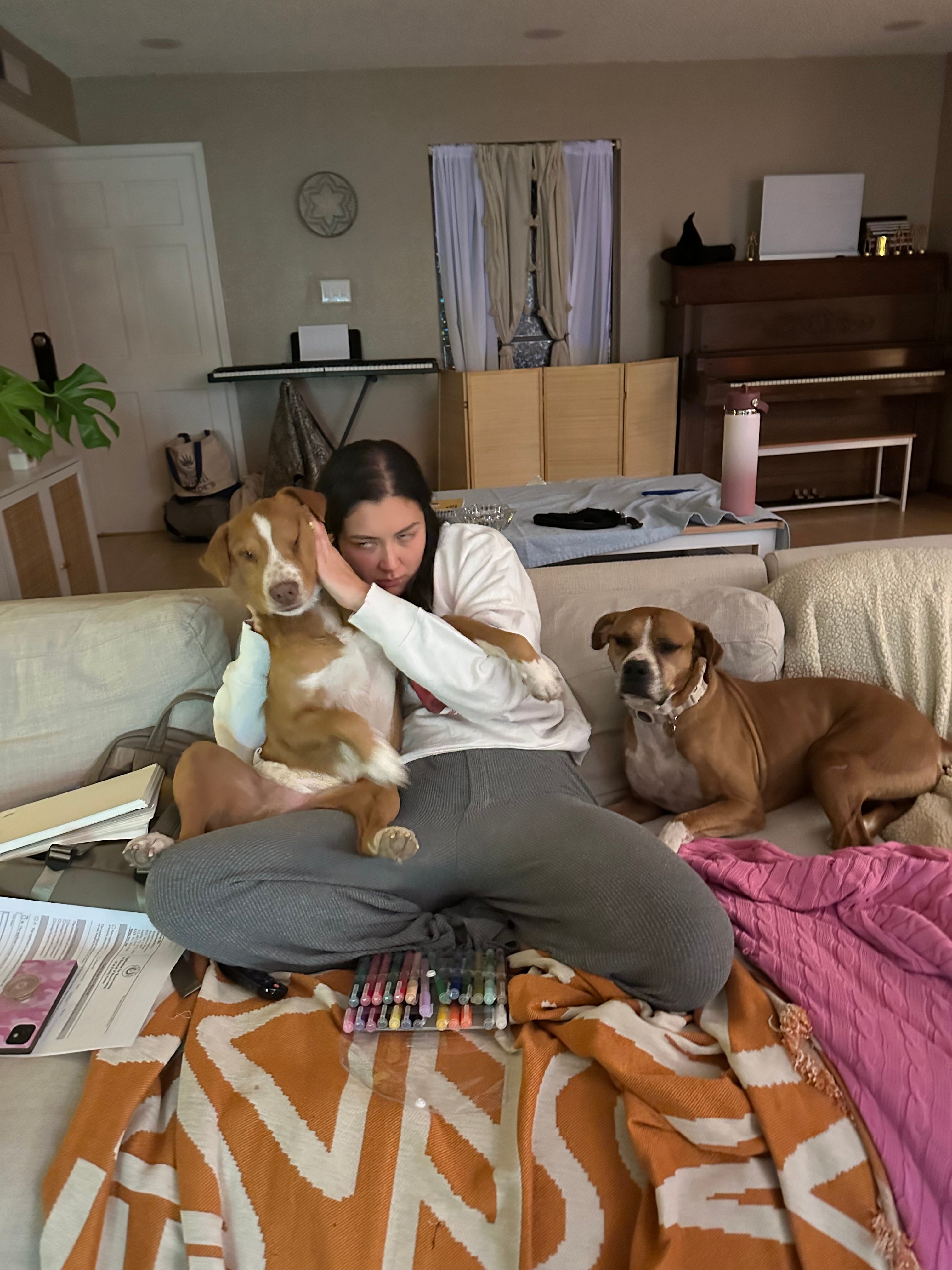
“Are you going to cry?” Miles asked me, then added, “It’s always the dogs that get me. They have no idea you’re leaving. It’s so sad, those clueless faces.”
I didn’t even consider the dogs when I was imagining my goodbye until Miles mentioned it. Yet, when looking back on my first reflection upon moving to El Paso, it was the animals who struck me as the most entertaining eyes to see this new world through. Lily, the diva. Patrick, the sad guy. Half-stache, the rogue outsider.
When I said goodbye to everyone, and the dogs (now just Pat and the newest addition, Manipup), I didn’t cry. Not until I got into the car at least. Then, I sobbed. It was sad to think I was leaving behind so much potential for new conversations, new activities, new dynamics to happen. It was also tearfully endearing to consider how much I learned over the past year and how special to have developed a relationship with wonderful people in a new place to the extent it felt like home.
While the Psychic Julie and I saw, as part of my bucket list of things to do before leaving El Paso, didn’t predict the $222 in our future, she did mention multiple times that I was getting in my own way (that’s what the spirits told to her, at least). Sure, she could’ve said this to anyone, but she said it to me and it resonated. I could feel that, I had felt that–especially when it came to this idea of progressing my life forward (whatever that meant).
The truth is, I’m a liar–I yearn like no other and refuse to desire so much that it twists me into embarrassing, hypocritical knots. While it’s easy for me to move physically, I find myself emotionally stuck quite frequently. Perhaps it’s because I push myself into environments and head spaces that I am convinced don’t need me. Perhaps I get so caught up with my “immediate surroundings” I lose sight of my big-picture purpose quite easily; my gender is more mood-based.
I had told Julie I was going to miss the dogs a 5/10. But honestly, I’ll admit, it’s more like a 6.
goodbyes also become a moral dilemma - like, do you “owe” anyone a goodbye? no, but I can understand how having a final hurrah feels good, appropriate.
not actually…I mean, it was probably something else (I wasn’t trained at anything) but the thought crossed my mind.
saying goodbye sometimes implies a see you never, which I don’t think is always true ❤️
Team black cats